Matching Scleral Design with Ocular Shape – Advancements in measurements and manufacturing can improve fitting efficiency and success.
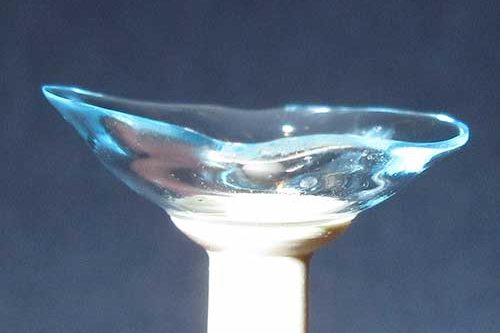
The majority of practitioners fitting scleral contact lenses rely on diagnostic lenses for fitting. Diagnostic lenses primarily allow practitioners to estimate the amount of sagittal depth needed to properly vault the chord diameter of the ocular surface that is being fit.
Visionary Optics recently introduced the Latitude scleral lens. According to the company’s research, most patients’ corneal and scleral shapes do not conform to scleral lens designs based upon peripheral curve systems. Its answer to this dilemma was to create the Latitude lens, which has no peripheral curve system; rather, it is a freeform lens designed to contour uniformly to each eye.
Objectives: To determine surface coverage of measurements using the sMap3D™ corneo-scleral topographer in patients presenting for scleral lens fitting.
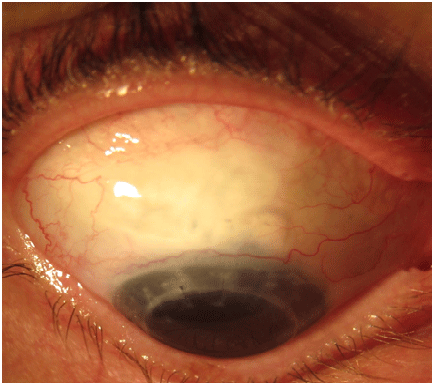
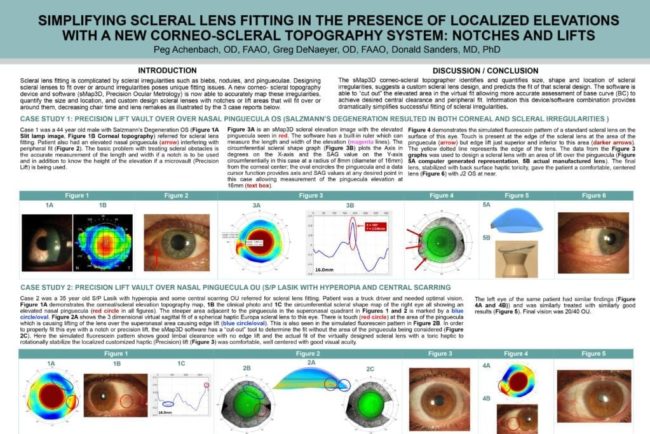
Scleral lens fitting can be challenging in the presence of localized conjunctival/scleral elevations (pingueculae or filtering blebs) in the area of the lens landing zone. We report on a case that was virtually fit successfully with a new corneal-scleral topography system.
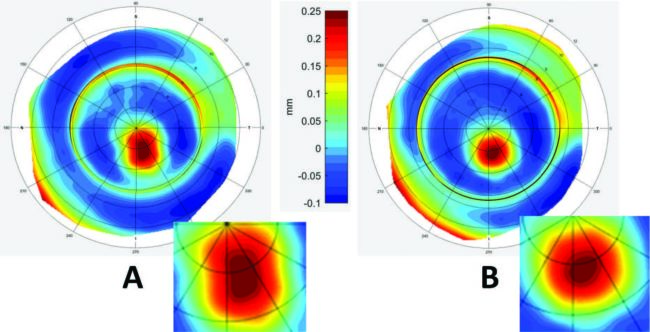
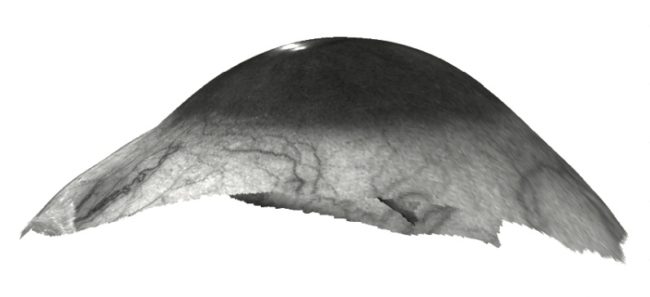
Objective was to examine new findings regarding conjunctival/scleral shape mapped with a novel wide field elevation topography device and software, to propose a new classification system for scleral shape.
Collagen Crosslinking for Keratoconus can Change Scleral Shape DeNaeyer G1, Sanders DR2 1 Optometrist at Arena Eye Surgeons, USA 2 Center for Clinical Research and President and CEO, Visionary Optics LLC, USA Abstract Collagen crosslinking (CXL) for keratoconus is known to decrease, halt, or even partially reverse progres-sion of keratoconus. We report on a case…
Scleral lens fitting can be challenging in the presence of localized conjunctival/scleral elevations (pingueculae or filtering blebs) in the area of the lens landing zone. We report on a case that was virtually fit successfully with a new corneal-scleral topography system.
Designing scleral lenses to fit over or around irregularities poses unique fitting issues. A new corneo-scleral topography device and software (sMap3D, Precision Ocular Metrology) is now able to accurately map these irregularities.
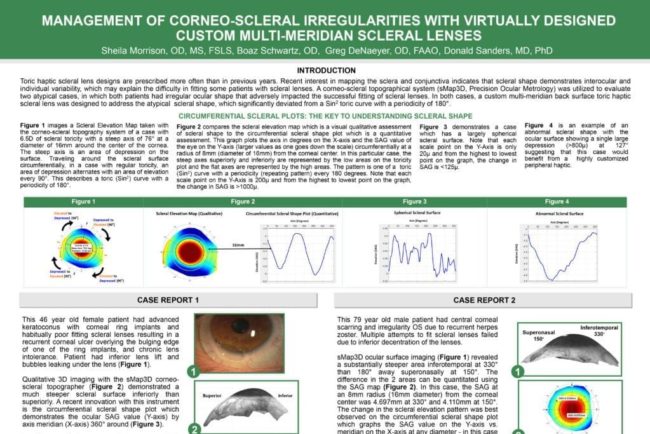
Toric haptic scleral lens designs are prescribed more often than in previous years. Recent interest in mapping the sclera and conjunctiva indicates that scleral shape demonstrates interocular and individual variability, which may explain the difficulty in fitting some patients with scleral lenses.
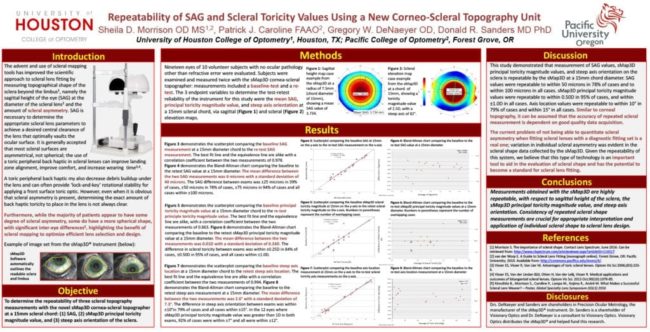
The advent and use of scleral mapping tools has improved the scientific approach to scleral lens fitting by measuring topographical shape of the sclera beyond the limbus, namely the sagittal height of the eye (SAG) at the diameter of the scleral lens and the amount of scleral asymmetry.